Source FTTH Installation Optical Power Meter for Testing, Maintenance, and Deployment
Compare 30 FTTH installation optical power meter options with varying models, certifications, and specifications. Buyers can evaluate features like wavelength calibration, battery life, and communication interfaces to find suitable devices for network testing and maintenance tasks.
Key considerations
Products List


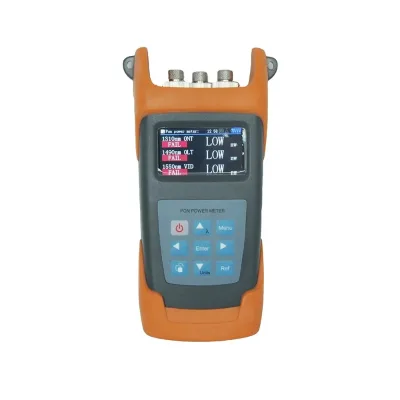
Comprehensive Sourcing Guide
Strategic Sourcing Guide for FTTH Installation Optical Power Meters
The deployment of Fiber to the Home (FTTH) networks relies heavily on the precision and reliability of testing equipment used during installation and maintenance phases. For procurement professionals, selecting the correct optical power meter is not merely a transactional decision but a strategic investment in network integrity. The market offers a diverse array of instruments, ranging from compact handheld units to sophisticated multi-wavelength analyzers. This guide synthesizes observed product attributes, technical specifications, and compliance data to provide a disciplined framework for sourcing these critical tools. Buyers must navigate a landscape where specifications vary significantly between models, requiring a rigorous approach to verification before finalizing any purchase order.
Technical Specifications and Wavelength Compatibility
The primary function of an optical power meter in an FTTH environment is to measure the power level of light signals transmitted through fiber optic cables. When evaluating potential suppliers, the first technical criterion to verify is the calibrated wavelength range. FTTH networks typically operate across specific spectral windows, most notably 1310 nm and 1550 nm for single-mode transmission, as well as 1490 nm for downstream data and 1310 nm for upstream. Some advanced units also support 850 nm and 980 nm for multimode applications or pump laser testing.
Observed product data indicates that high-performance meters often feature a calibrated wavelength range spanning from 800 nm to 1700 nm. This broad spectrum ensures compatibility with legacy systems and future-proofing for next-generation deployments. Specific models in the current market are noted to support fixed wavelengths such as 1310 nm and 1550 nm, often with a "Twin Function" capability that allows for simultaneous or rapid switching between these critical bands. The detector type is another vital specification; Ingaas (Indium Gallium Arsenide) detectors are the industry standard for single-mode fiber testing due to their superior sensitivity and linearity in the near-infrared region.
Resolution is the third pillar of technical evaluation. The ability to distinguish minute changes in signal strength is crucial for identifying fiber degradation or connector issues. Market observations show resolution values as fine as 0.01 dB and 0.03 dB. A resolution of 0.01 dB is particularly valuable for high-precision loss measurements in dense network environments. Buyers should verify that the specified resolution is consistent across the entire operating range, as some devices may degrade in accuracy at the extreme ends of their wavelength spectrum. Furthermore, the identification frequency range, often cited between 10 Hz and 60 kHz, is relevant for units that integrate tone generation or frequency identification features, aiding in cable tracing during complex installations.
Compliance, Certification, and Regulatory Standards
In the B2B procurement of electronic testing equipment, compliance is non-negotiable. Regulatory bodies in various regions mandate specific certifications to ensure safety, electromagnetic compatibility, and environmental sustainability. When sourcing optical power meters, buyers must demand proof of valid certifications rather than relying on marketing claims. The observed product data highlights a consistent pattern of compliance with major international standards.
Key certifications to verify include CE (Conformité Européenne), which indicates compliance with European health, safety, and environmental protection standards. RoHS (Restriction of Hazardous Substances) is equally critical, ensuring that the device does not contain restricted hazardous materials such as lead or mercury. Additionally, CCC (China Compulsory Certification) is often required for products manufactured in or imported into China, while ISO 9001 certification indicates that the manufacturer adheres to a recognized quality management system. Some suppliers also list ISO, GS, and RoHS together, suggesting a robust commitment to global market standards.
Beyond product-level certifications, buyers should verify the uncertainty of measurement. In precision instrumentation, uncertainty defines the range within which the true value of a measurement lies. Observed data points to an uncertainty of ±5%, a figure that must be understood in the context of the specific application. For general FTTH installation, this level of uncertainty may be acceptable, but for high-precision network auditing, a lower uncertainty value might be required. The procurement team should request a calibration certificate that explicitly states the measurement uncertainty and the traceability of the calibration to national standards.
Cost Drivers and Pricing Structures
Understanding the cost structure of optical power meters is essential for budgeting and total cost of ownership analysis. The observed price range for these devices spans from $9 to $2,878 USD, a variance that reflects differences in functionality, build quality, and brand positioning. The lower end of the spectrum typically includes basic handheld units suitable for simple on/off checks or low-precision installations. These units may lack advanced features like wide wavelength calibration or high-resolution displays.
Conversely, the upper end of the price range corresponds to multi-function analyzers that offer extensive wavelength support, high-resolution displays, and advanced connectivity options. Cost drivers include the quality of the detector, the precision of the internal calibration, and the durability of the housing. For instance, units designed for rugged field use often feature reinforced casings and moisture-proofing, which adds to the manufacturing cost. The presence of a battery with a long operating time, such as 24 hours, is another value-added feature that can justify a higher price point, as it reduces downtime for technicians in the field.
Buyers must also consider the Minimum Order Quantity (MOQ) and its impact on unit economics. Observed data indicates an MOQ of 1 piece for many suppliers, which is favorable for small-scale procurement or pilot testing. However, for large-scale network rollouts, negotiating volume discounts is essential. The packaging method, whether standard carton boxes, polyfoam, or double brown boxes, can also influence shipping costs and the risk of damage during transit, indirectly affecting the total cost.
Typical Applications and Operational Requirements
Optical power meters serve distinct roles across the lifecycle of an FTTH network. The primary application is in the installation phase, where technicians use the device to verify that the optical signal strength meets the design specifications before handing over the service to the customer. In this context, the device must be portable, easy to use, and capable of quick readings. Features such as a built-in battery and a clear display are paramount.
Beyond installation, these meters are critical for maintenance and troubleshooting. When a network fault occurs, technicians need to isolate the point of failure by measuring power levels at various points in the network. The ability to identify specific wavelengths, such as 1310 nm and 1550 nm, allows technicians to distinguish between different signals and identify cross-talk or leakage issues. Some advanced models include a "Twin Function" that simplifies the testing process by allowing for simultaneous measurement of multiple wavelengths, significantly reducing the time required for complex diagnostics.
The operational environment also dictates specific requirements. FTTH installations often take place in diverse conditions, from residential basements to outdoor cabinets. Therefore, features like moisture-proofing and a wide operating relative humidity range (0 to 95%) are essential for ensuring the device's longevity and reliability. The physical dimensions of the meter, such as 210x115x55 mm or 172x82x33 mm, determine its portability. A compact form factor is generally preferred for field technicians who carry multiple tools, while larger units might be reserved for laboratory or fixed-station testing.
Supplier Evaluation and Lead Time Management
Selecting the right supplier is as important as selecting the right product. In the context of the observed data, suppliers are primarily located in China, with specific manufacturing hubs in Hangzhou, Zhejiang, and Shenzhen. These regions are known for their robust electronics manufacturing ecosystems. When evaluating suppliers, buyers should look for evidence of a stable supply chain and a history of meeting delivery commitments.
Lead time is a critical factor in procurement planning. Observed data shows lead times ranging from 3 to 5 working days for some models, while others may have different timelines. For urgent procurement needs, suppliers with shorter lead times are preferable. However, buyers must balance speed with reliability. A supplier that consistently meets a 5-day lead time is often more valuable than one that promises 3 days but frequently delays. Customization options, such as specific packaging or branding, are available from many suppliers, but these requests can extend the lead time. Buyers should clarify the impact of customization on the delivery schedule before placing an order.
The communication interface is another aspect of supplier evaluation. Some models feature an RS232 interface, allowing for data transfer to a computer or network management system. This capability is valuable for automated testing and reporting. Buyers should verify that the supplier provides the necessary drivers and software to utilize these interfaces effectively. Additionally, the availability of spare parts and after-sales support should be considered, as these factors influence the long-term viability of the procurement relationship.
Quality Control and Long-Term Procurement Considerations
Ensuring the quality of optical power meters requires a proactive approach to quality control. Buyers should implement a rigorous inspection process upon receipt of goods. This includes verifying the physical condition of the units, checking for any damage to the packaging, and testing the functionality of the device against known standards. The observed product attributes, such as "New" condition and specific packaging types like "Carton Box" or "Packed with Polyfoam," provide a baseline for what to expect.
Long-term procurement considerations extend beyond the initial purchase. Buyers should evaluate the supplier's ability to provide consistent quality over time. This includes verifying that the calibration standards remain valid and that the supplier can support the device with firmware updates or technical assistance. The uncertainty of measurement, observed at ±5%, should be monitored over time to ensure it does not drift beyond acceptable limits. Regular recalibration is often necessary to maintain accuracy, and buyers should inquire about the supplier's calibration services and turnaround times.
Furthermore, the customization of the product, such as specific branding or packaging, can be a strategic advantage for large enterprises. However, this must be balanced against the potential for increased complexity in the supply chain. Buyers should establish clear specifications for customization to avoid misunderstandings and ensure that the final product meets the intended requirements. By focusing on these quality control and long-term considerations, procurement professionals can secure a reliable supply of optical power meters that support the efficient and effective deployment of FTTH networks.
FAQs
What is the typical lead time for ftth installation optical power meters?
The typical lead time ranges from 3 to 5 working days for standard models. Some specific units like the SFT3213A require 3 to 5 working days, while others may take up to 5 days depending on customization needs.
Which certifications are commonly available for these optical power meters?
Common certifications include CE, RoHS, ISO, and CCC for compliance with international standards. Specific models often list ISO, GS, and RoHS together to ensure safety and environmental sustainability for global deployment.
Can I find ftth installation optical power meters with a 24-hour battery life?
Yes, certain models feature a battery operating time of 24 hours for extended field use. This long battery life ensures technicians can work throughout the day without needing frequent recharges during critical network installations.
What is the minimum order quantity for purchasing these meters?
The minimum order quantity is typically 1 piece for many suppliers. This low MOQ allows buyers to purchase single units for pilot testing or small-scale network rollouts without committing to large bulk orders.
Which wavelength ranges do these meters support for calibration?
Calibrated wavelength ranges typically span from 800 nm to 1700 nm to cover all FTTH bands. Specific models support fixed wavelengths like 1310 nm and 1550 nm, as well as 850 nm and 980 nm for multimode applications.
Where are the manufacturers of these optical power meters located?
Manufacturers are primarily located in China, with hubs in Hangzhou, Zhejiang, and Shenzhen. These regions offer robust electronics manufacturing ecosystems capable of producing both standard and customized testing equipment.
How is the product typically packed for shipping?
Products are packed in carton boxes, polyfoam, or double brown boxes for protection. Some units are packed with polyfoam and double packed with brown boxes to ensure safety during transit to various global destinations.